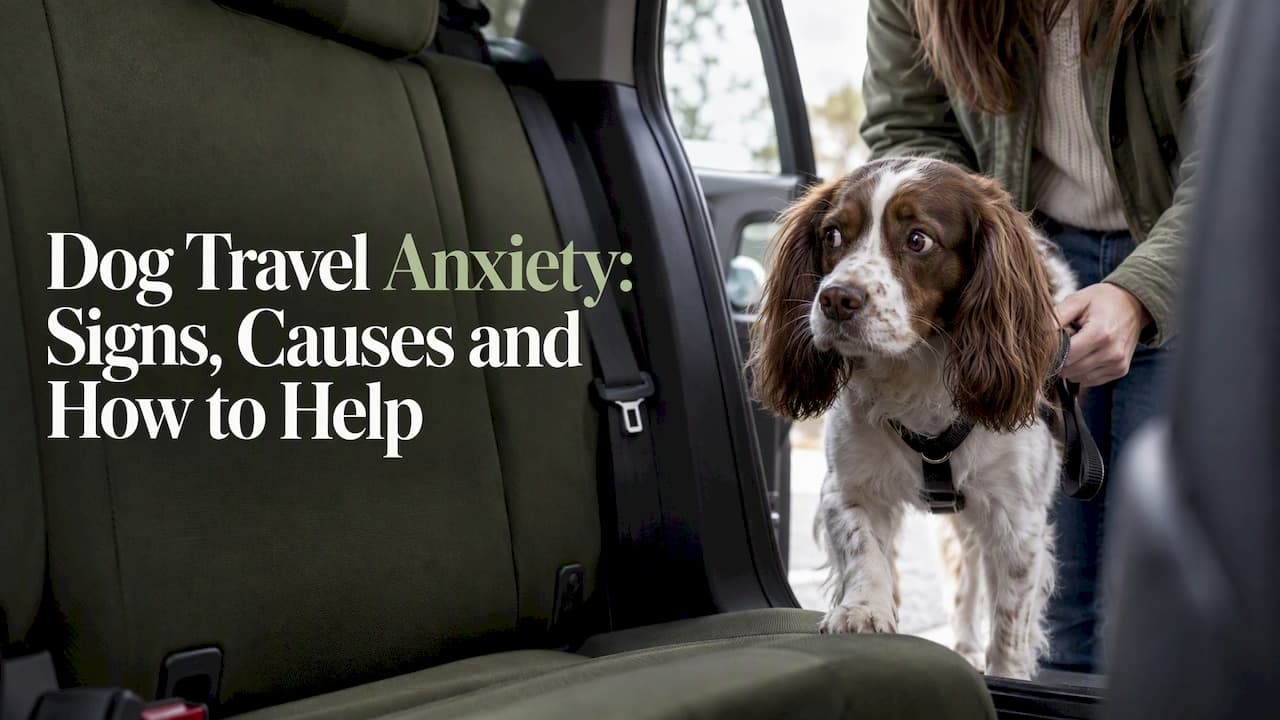
Most dogs that dread the car are not being difficult. They are drooling, pacing or feeling sick because the journey really does feel bad to them. The fix usually combines three things: working out whether the problem is fear, nausea or both, retraining the car so it predicts something pleasant, and talking to your vet early if the signs are strong. This guide walks through each, then covers the extra planning that long journeys, including trips to Europe, need.
TL;DR
- Typical signs are drooling, panting, pacing, whining, barking, trembling, vomiting and trying to escape. Vomiting or heavy salivation while the car moves points towards motion sickness.
- Fear of the car can cause nausea, and nausea can then make the fear worse. Both need dealing with.
- Gradual travel training, starting beside a parked car and building up to short trips, is the best long-term answer. Calming aids can support it but rarely replace it.
- Ask your vet before giving any medication, human remedies included. Some dogs need a prescription for severe sickness or fear.
- For long trips, keep your dog restrained, keep the car cool, and cut the number of strangers and handovers wherever you can.
Table of Contents
- What dog travel anxiety looks like
- Why some dogs become anxious in the car
- Is it fear or car sickness?
- Step by step: travel training that works
- On the day: making the car calmer
- Calming aids: what may help and what to be careful about
- When to talk to your vet
- Our view on anxious dogs and long journeys
- Travelling abroad with an anxious dog
- How Pettaxi can help with the journey
- FAQ
- Sources
What dog travel anxiety looks like
The signs are easy to miss early on because they start small. According to VCA Animal Hospitals, dogs that struggle with travel may salivate, become restless, pace, whine, howl, bark or vomit. VetHub is not needed to recognise the pattern: it is the same cluster of behaviours you would see from a dog that is frightened of anything else, only it happens when the engine starts.
Look for these, roughly from mild to severe:
- Lip licking, yawning and turning away as you open the car door
- Refusing to jump in, or freezing at the boot
- Panting and drooling once the car is moving
- Whining, barking or howling
- Pacing, being unable to settle, scrabbling at windows or doors
- Trembling or hiding in the footwell
- Vomiting, urinating or soiling
- Trying to escape when the car stops or a door opens
Watch when the signs begin. A dog that is already trembling on the driveway is anticipating the trip. A dog that is fine until the car turns the first few corners and then starts drooling may be feeling sick.
Why some dogs become anxious in the car
There is rarely one cause. The American Kennel Club lists motion sickness, bad past experiences such as an accident or a stressful vet visit, and associating the car only with unpleasant destinations as common reasons for distress.
That last one is the easiest to fix and the most overlooked. If every car trip ends at the vet or the groomer, a clever dog learns quickly what the engine noise predicts. Puppies that never ride in a car until the day they are taken to be vaccinated often start with that handicap.
Other common contributors:
- Poor early exposure. A dog that has never been in a car, or only on unusual occasions, finds the movement, noise and smell unfamiliar.
- Being unsteady. A dog sliding around on a seat or in an open boot cannot brace itself. Secure, stable positioning helps both comfort and safety.
- Heat and stuffiness. A hot car makes any dog feel worse.
- A bad experience that stuck. One frightening journey can be enough to start the pattern.
Is it fear or car sickness?
The two overlap more than most owners realise. The Merck Veterinary Manual notes that fear of the vehicle can contribute to motion sickness in dogs and cats through a conditioned response. In plain terms: a dog is sick in the car once, feels dreadful, then starts to fear the car, and the fear itself brings on nausea.
This matters because the treatments differ. A few pointers:
| Clue | More likely fear | More likely motion sickness |
|---|---|---|
| When it starts | Before the engine, at the sight of the car | After a few minutes of movement |
| Main signs | Trembling, hiding, escape attempts, barking | Drooling, lip licking, vomiting, lethargy |
| Short trips round the block | Still distressed | Often milder, gets worse with distance |
| Parked in the car, engine off | Often still tense | Usually fine |
Many dogs sit in between. If you cannot tell, a vet can help you separate the two. VCA advises seeking veterinary advice if your dog shows distress, particularly salivation or vomiting while the car is moving, because motion sickness may be involved.
Step by step: travel training that works
The UK charity PDSA describes patient travel training as the best long-term solution for car sickness and travel stress. It starts near the car, moves to stationary practice, and progresses to short and then longer trips. The principle, often called desensitisation, is to reward your dog for looking at or approaching the car so it builds positive associations, with treats or toys doing the work.
Here is one way to run it. Move on only when your dog is relaxed at the current step. If the dog shows signs of stress, go back a step rather than pushing through.
- Near the car. With the car parked and silent, scatter treats or play a short game a few metres from it. Let your dog decide whether to come closer. Reward looking at the car, then walking towards it.
- At the open door. Feed treats beside the open door. Do not lift or push your dog in.
- Inside, engine off. Reward your dog for stepping in on its own, then for settling. Keep sessions short and end while your dog is still calm. Use a chew or a favourite toy that only appears in the car.
- Engine on, no movement. Start the engine for a few seconds, reward, switch off. Build up the time over several sessions.
- Tiny trips. Drive to the end of the road and back. Then round the block. Finish somewhere your dog enjoys, such as a park or a favourite walk, so the car predicts something good.
- Longer trips. Extend gradually, mixing in fun destinations and plenty of ordinary short journeys that end at home.
Progress is slow for some dogs and quick for others. Long-term behaviour modification can be time-intensive and has to run at the animal's pace. An academic review in the Journal of the American Veterinary Medical Association notes that severe cases often need the guidance of a veterinary behaviourist. If weeks of careful work are going nowhere, that is the next step, not a failure on your part.
On the day: making the car calmer
Training sets up the long game. These adjustments help on any individual journey.
Secure your dog properly
The AKC advice is to restrain your dog in a crate or with a car harness, which also keeps everyone safe. A dog that is held steadily, with room to lie down, often settles faster than one wandering the back seat. Introduce the crate or harness at home first, so it is not another unfamiliar thing on the day.

Keep the car cool and fresh
The AKC also recommends keeping the car cool and lowering the windows slightly for fresh air. Cool air alone helps many dogs that are feeling queasy. Do not let your dog put its head out of a fully open window.
Never leave a dog in a parked car in warm weather. The American Veterinary Medical Association warns that car interiors heat up much faster than the air outside, and even a short time can be dangerous. On long trips, plan breaks where someone stays with the dog and the car is shaded or cooled.
Plan the timing and the breaks
- Walk your dog before you leave, so it starts tired and having toileted.
- Pick quieter roads and times if you can, since traffic noise and stop-start driving add to the stress.
- Stop regularly on long journeys for water, a short walk and a calm check-in. Keep your dog on a lead and secure at every stop.
- Bring familiar bedding and a favourite toy, so the car smells of home.
- Stay calm yourself. Dogs read tone, and a fussing owner confirms that something is wrong.
Keep interaction gentle
Offer calm, positive attention without forcing your dog into anything it finds frightening. If your dog wants space, give it. If it takes a chew, let it.
Calming aids: what may help and what to be careful about
There is a crowded market of sprays, collars and supplements. PDSA says that pheromone collars, calming supplements or compression coats may help some dogs, but they sit alongside training rather than replacing it. Think of them as extras that may lower the starting level of stress, so that training can work.
Two cautions are worth making.
Human remedies are not the answer. PDSA advises that human anti-sickness medicines and non-prescription home remedies are often ineffective and can cause side effects in dogs. Do not reach for the family medicine cabinet.
Prescription options exist for the severe cases. PDSA says prescribed anti-sickness medication can be a short-term option for severe car sickness. The Merck Veterinary Manual names maropitant citrate (Cerenia) as the preferred drug for motion sickness in dogs, and notes that nausea is harder to manage with drugs than vomiting. For fear-related behaviour, Merck says trazodone or gabapentin, alone or together, may be given one to two hours before travel to reduce stress and fear-related behaviours. That is a prescription decision, not a do-it-yourself one. Your vet chooses based on your dog's symptoms, health history and any other medication it takes, and dose and timing are theirs to set.
You will see claims online that particular supplements, including cannabidiol products, solve car anxiety. Evidence for individual products varies, and none of it replaces a vet's judgement about your own dog. Ask your vet before you try one.

When to talk to your vet
Book an appointment rather than waiting it out if:
- Your dog drools heavily or vomits whenever the car moves
- Distress is strong enough that your dog tries to escape, injures itself or soils the car
- Training has stalled, or the signs are getting worse
- You have a long or unavoidable journey coming up, such as a move, and need a plan
- Your dog is older, has a health condition or is on other medication
VCA advises owners to consult a vet before giving any medication, who can help choose the best option based on the dog's behaviour and health history. Tell them exactly when the signs begin and what they look like. A short phone video of your dog in the car is genuinely useful. If the problem is severe or tied up with other fears, ask whether a referral to a veterinary behaviourist makes sense.
Our view on anxious dogs and long journeys
We move dogs, cats and ferrets between London and Europe, so we see the other side of this problem: owners who can train a dog for a drive to the coast, but face a journey of several hours and a border crossing with a nervous animal.
What we have learned is that the journey's structure matters as much as the dog's temperament. Every handover is a new stranger, a new smell, a new noise and a new moment where the dog is away from its person. That is why we run our service the way we do: your dog travels beside you in a private vehicle for the whole trip, so there is no crate in a hold and no hand-off to a stranger at either end.
We are not vets and we do not claim to cure anxiety. If your dog is already struggling with the car, speak to your vet well before the trip and rehearse with short drives. What we can do is remove avoidable stresses on the day: a licensed, insured driver who is DEFRA Type 2 approved, a vehicle that is not shared with other animals, document checks done properly before you set off, and a plan for stops. You can reach our team over live chat to ask how the journey would work for your dog.
One practical tip we give often: do a dress rehearsal. Put the harness or crate in the vehicle you will use, pack the bedding and chews, and take your dog for a short drive that ends somewhere nice. It tells you far more about how the real trip will go than any amount of guessing.
— Alexandru
Travelling abroad with an anxious dog
Crossing to Europe adds paperwork and waiting time to the usual stresses. A few things to plan:
- Documents first. Paperwork problems at the border create stress for you, and dogs feel it. Check microchip, rabies vaccination and the animal health certificate or passport arrangements that apply to your route and date, and allow time for tapeworm treatment for dogs where required. Our guide on Paris to London with a dog walks through the Eurotunnel crossing in detail.
- Choose the calmest mode. Air travel means a crate in a hold, noise and strangers. Many anxious dogs do better in a car with their owner, and the Eurotunnel allows pets to stay in the vehicle during the crossing.
- Know who is carrying your pet. If you hire a transporter, ask whether the driver is licensed and approved for animal transport. Our article on DEFRA Type 2 pet transport explains what that approval means.
- Allow for rest. Long distances need stops. Build them into the schedule rather than rushing.
- Rehearse. Practise the journey type, not just the car. If your dog will be in a crate or harness for six hours, build up to long drives first.
If your dog is a cat or ferret rather than a dog, similar principles apply, and our guide to London to Paris with a cat covers the cat side.
How Pettaxi can help with the journey
If you are moving or travelling between the UK and Europe with a dog that finds travel hard, a private door-to-door journey removes many of the triggers: the dog stays with you, in one vehicle, from pick-up to drop-off. Our drivers are DEFRA Type 2 approved, with commercial insurance and private hire licensing, and we verify your pet's microchip, rabies, AHC or EU passport and tapeworm treatment documents before departure. All motorway tolls are included in the fixed quote, which is based on mileage, and you pay for the journey and the Eurotunnel ticket at the terminal.
Published prices start at £340 from London to Calais, £465 from London to Lille, £575 from London to Brussels and £715 from London to Paris, all as "from" prices for a one-off journey. You can see every route, including Amsterdam, Zurich, Geneva, Milan, Barcelona and Madrid, on our routes page, or start from the Pettaxi home page.
FAQ
Why does my dog shake and drool in the car?
It is usually fear, nausea or both. Drooling and vomiting while the car is moving suggest motion sickness, while trembling and escape attempts before the engine starts suggest fear. The two often feed each other, so see your vet if the signs are strong or persistent.
Can I give my anxious dog human travel sickness tablets?
No, not without veterinary advice. PDSA says human anti-sickness medicines and non-prescription home remedies are often ineffective and can cause side effects in dogs. Your vet can prescribe medicine made for dogs if your dog needs it.
Will my dog grow out of car anxiety?
Some young dogs get used to travel as they gain experience, but a dog that has been frightened or sick usually needs gradual training. Short, rewarding trips that end somewhere pleasant are the core of that training. If progress stalls, ask your vet about a behaviourist.
How should an anxious dog travel in the car?
Securely restrained in a crate or car harness, with the car kept cool and fresh air coming in. Offer calm, gentle company and never force your dog into a situation it finds frightening. On long trips, plan regular breaks and never leave your dog alone in a parked car in warm weather.
Is it better to travel with an anxious dog by car than by plane?
For many anxious dogs, a car journey with their owner is gentler than a flight, because there are fewer strangers and handovers and your dog stays with you. It still depends on the dog, so rehearse long drives first and talk to your vet if you are unsure.
Sources
- VCA Animal Hospitals: Traveling by air and car with your dog
- American Kennel Club: Teaching your dog to ride in the car
- Merck Veterinary Manual: Motion sickness in animals
- PDSA: Car sickness and motion sickness in dogs
- Best Friends Animal Society: How to relieve dog car anxiety
- Journal of the American Veterinary Medical Association: pharmacological treatment options
- American Veterinary Medical Association: pet safety in warm weather