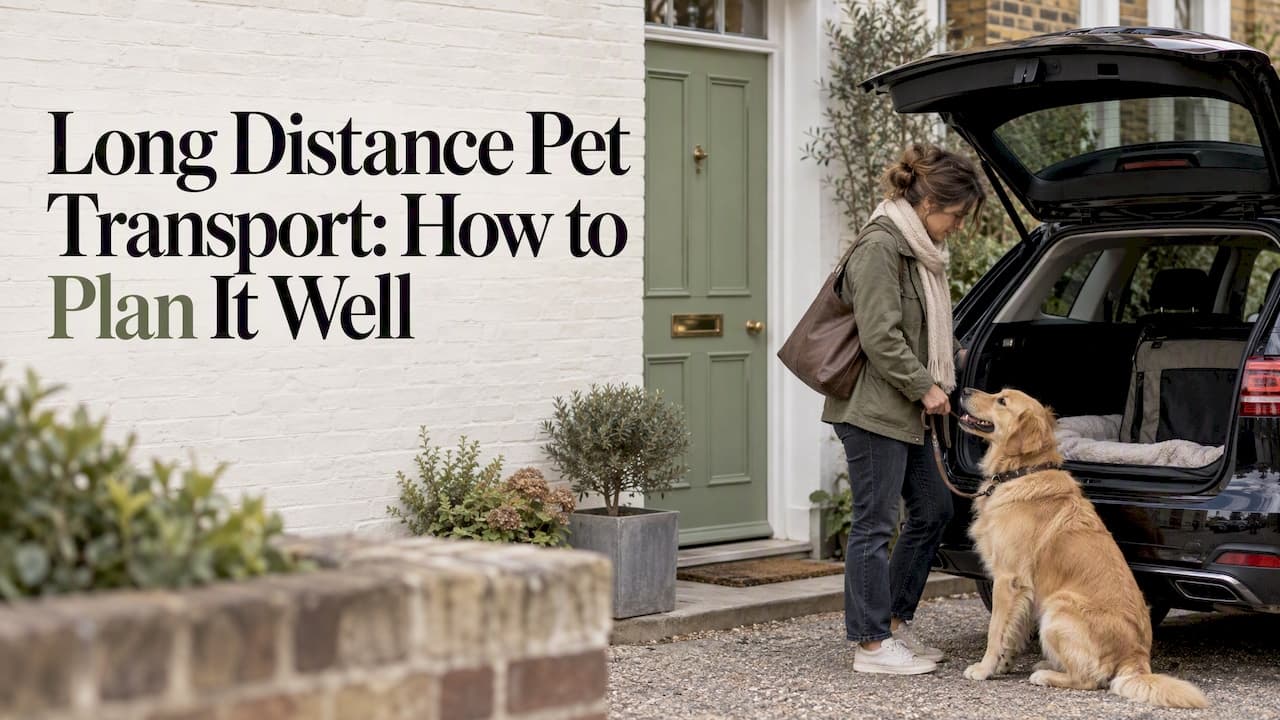
Long distance pet transport means moving a dog, cat or ferret over several hundred miles, usually across a border, by road, air or a mix of both. For most people leaving London for the Continent, the calmest option is a private road journey in which the pet stays beside the owner the whole way. You skip the cargo hold, the handovers and the separation. This guide covers how the options compare, the paperwork, how to keep your animal comfortable, and why the price is what it is.
TL;DR
- A journey of over 8 hours needs a Type 2 transporter authorisation if someone carries your pet for hire in Great Britain, so ask any provider to show theirs.
- Going from Great Britain to the EU, your dog, cat or ferret needs a new animal health certificate for each trip, plus a microchip and a valid rabies vaccination.
- Door-to-door road transport with you in the vehicle avoids the handovers and cargo-hold separation that make air freight stressful for many animals.
- Cost follows mileage, vehicle time, crossing fees and paperwork. Our fixed quotes run from £210 (Ashford to Calais) to £2,635 (London to Rome).
- Start the vet and paperwork steps early, because the certificate window is short and appointments can be scarce.
Table of Contents
- What long distance pet transport actually involves
- Road or air: which suits your pet
- Paperwork for UK to Europe
- Who is allowed to carry your pet
- Preparing your pet for a long journey
- Why long distance pet transport costs what it does
- Our perspective
- Book a door-to-door journey with us
- A simple timeline
- FAQ
- Sources
What long distance pet transport actually involves
There are three broad models, and they feel very different to the animal.
Pet shipping or relocation agents. Your pet is collected, handed to a courier or airline, flown or driven, and handed over again at the other end. You usually travel separately. It works, but your pet is in other people's custody for the whole trip.
Flying with the pet. Airlines decide which animals they accept, on which flights, and in which container. The IATA guidance for travellers says to contact the airline well in advance, because airlines may limit the number of pets on a given flight, and a veterinary health certificate is required in relevant cases.
Personal pet taxi by road. A driver collects you and your pet at your door, and you travel together in a dedicated vehicle to the destination address. That is the model we run. Nobody else's animals are on board, and your pet never leaves your sight.
If you want a plain test for any provider, ask three questions. Who has custody of the animal at each stage? How many handovers are there? Can you see your pet throughout? The fewer the handovers, the fewer the moments where something can go wrong.

Road or air: which suits your pet
Air travel is sometimes the only realistic way to cover intercontinental distances. Within the UK and Europe, road is often the better choice for the animal.
The American Red Cross recommends a direct flight where possible, travelling on the same flight as the pet, and avoiding cargo travel in temperatures above 85°F or below 45°F. Those are the conditions you have to manage if your pet flies in the hold.
The WSAVA welfare factsheet on dogs and cats in transport says planning should weigh fitness, age, breed, medical conditions, emotional state and tolerance of the carrier, and it flags airline restrictions that affect flat-faced (brachycephalic) breeds. If your pug, French bulldog or Persian is on that list, road is usually simpler.
| Factor | Hold or cargo flight | Private road journey |
|---|---|---|
| Is the owner with the pet? | Usually not, or only on the same flight | Yes, in the same vehicle |
| Handovers | Several (check-in, handling, collection) | None |
| Breed or species limits | Set by each airline | Set by the vehicle and the pet's health |
| Door-to-door | No, airport to airport | Yes |
| Best for | Intercontinental moves | UK to Europe and back |
Paperwork for UK to Europe
Rules change, so treat the official pages as the final word. This is what applies at the time of writing for travel from England, Scotland and Wales.
GOV.UK states that you need an animal health certificate for your dog, cat or ferret when travelling from Great Britain to an EU country. It is valid for entry within 10 days of your vet issuing it, so the timing of the vet appointment matters. You need a new certificate for each separate trip, and the wider GOV.UK pet travel guidance covers the microchip, rabies vaccination and tapeworm treatment for dogs entering certain countries.
In practice, your checklist looks like this:
- Microchip. It must be implanted before the rabies vaccination, and the number must match every document.
- Rabies vaccination. It must be valid for the date of travel.
- Animal health certificate. It must be issued by an official veterinarian within the 10-day window.
- Tapeworm treatment for dogs. It is required only for certain destinations, and it has a set time window before arrival.
- Return plan. The same certificate has a validity for re-entry to Great Britain, but check the current terms before you leave.
Going the other way, the APHA list of approved carriers and routes shows that pets entering England or Scotland generally have to use approved carriers and routes. That includes the Channel Tunnel, which our journeys use. Our guide to France to UK pet documents walks through the return leg in more detail.
We check microchip, rabies, AHC or EU passport and, for dogs, tapeworm treatment before departure. A mismatch found at the terminal is a bad moment. A mismatch found at your kitchen table is a phone call to the vet.
Who is allowed to carry your pet
Carrying animals for hire is regulated in Great Britain. According to GOV.UK guidance on transporting animals, you need a UK-issued transporter authorisation if you move animals over 65km by air, road, rail or sea. That means Type 1 for journeys up to 8 hours and Type 2 for journeys over 8 hours. Authorisations are valid for up to 5 years, and the holder has to carry a copy and show it on request.
So before you book anyone, ask to see the authorisation, check that the type matches the journey length, and ask about vehicle insurance and licensing. All our drivers are DEFRA Type 2 approved, with commercial insurance and private hire licensing.
Preparing your pet for a long journey
Most of what keeps an animal calm happens before the day.
Check fitness and temperament. WSAVA advises assessing the animal's fitness and emotional health, and getting it used to the crate and travel sounds gradually. An elderly cat with kidney problems or an anxious rescue dog needs a different plan from a young, confident spaniel. Speak to your own vet about it.
Practise short drives. The AVMA's dog and cat travel guide recommends crate acclimation, car practice beforehand, a veterinary examination and parasite prevention. It also advises up-to-date identification tags and checking that your microchip details are registered.
Use the right restraint. The Red Cross says cats should travel in carriers and dogs in a carrier or seat-belt harness. Pets should never ride in the front passenger seat, hang their heads out of windows or be left alone in a parked car.
Pack a small travel kit. The same AVMA guide suggests carrying vaccination and medical records, a recent photograph, a lead, food, water, medicines and the number of an emergency vet. We would add familiar bedding, since a blanket that smells of home settles many animals.

Know what the Channel crossing is like. The Welsh Government's journey welfare guide for dogs and cats warns that ventilation in a vehicle is reduced during ferry or Channel Tunnel travel. On a Eurotunnel crossing the pet stays in the vehicle with you, so you can see and reassure your animal throughout.
Breaks, food and water
Plan stops for water and toilet breaks on any journey over a few hours. Feed a lighter meal than usual several hours before departure, and keep water available. Never open a door or window in an unfamiliar car park while the pet is loose in the vehicle. A driver who has done the route many times knows which stops are practical, and that is a real advantage of a dedicated vehicle.
Why long distance pet transport costs what it does
People often ask why this is expensive. Taking a vehicle and a licensed, insured driver off other work for most of a day, or more, is the main reason. Several things move the price:
- Distance and driving time. Our quotes are fixed and based on mileage. Tolls are included.
- Crossing costs. The Eurotunnel ticket is paid separately at the terminal, in addition to the service fee.
- Direction and start point. Collection from Leeds is a longer trip than from central London, so the price reflects it.
- Compliance. Document checks, licensing and commercial insurance are costs of doing the job properly.
- Time away. Long routes, such as London to Madrid, involve overnight stops and a driver who still has to return.
Cheaper options exist, but ask what is left out. Is it a shared vehicle with other animals? Is the authorisation current? Do you travel with your pet? A low quote that skips those answers is not the same service.
Our published starting prices
These are the fixed-quote starting prices listed on our site for one-off journeys:
| Route | From |
|---|---|
| Ashford to Calais | £210 |
| London to Calais | £340 |
| London to Lille | £465 |
| London to Brussels | £575 |
| London to Jersey | £602 |
| London to Paris | £715 |
| London to Amsterdam | £765 |
| London to Geneva | £1,330 |
| London to Zurich | £1,410 |
| London to Milan | £1,885 |
| London to Barcelona | £2,110 |
| London to Madrid | £2,460 |
| London to Rome | £2,635 |
Paris CDG to London starts from £690 and Orly to London from £755. Leeds to Paris starts from £1,055, and Alicante to London from £2,411. The Eurotunnel ticket is on top. See the full list of routes for the rest.
Our perspective
We started from a simple observation: most pet owners are not worried about the distance. They are worried about the moments when someone else has their animal. A cat carrier passed from a courier to a depot to a van is a cat that cannot hear its owner's voice.
So we built the service around one rule. The owner and the pet travel together, in one vehicle, from the front door to the destination door. Because we do not collect other people's animals en route, there is no schedule to wait for and no one to hand over to.
What surprises people is how much of the job is paperwork. A good driver is only half of it. The other half is checking the microchip number against the certificate, the rabies date against the travel date and the tapeworm window against the crossing time, before the car leaves. We would rather delay a departure by a day than turn around at the border.
Our advice, whichever provider you choose: ask who holds your pet at every moment, ask to see the Type 2 authorisation, and book the vet appointment before you book anything else.
— Alexandru
Book a door-to-door journey with us
If you are moving between London and Europe with a dog, cat or ferret, we collect you both at your address and drive you to the destination in a dedicated vehicle. The service includes document verification, motorway tolls, luggage assistance, Eurotunnel transit and airport meet-and-greet where needed. Live chat support and multilingual route guides come with it.
The most requested routes are London to Paris from £715, London to Brussels from £575 and London to Amsterdam from £765. Coming back, we run Paris to London and Amsterdam to London. Not on the list? Start from Pet Taxi London and ask for a fixed quote. If you are travelling with a cat, our guide to London to Paris with a cat is a good first read.
A simple timeline
Here is the order we would work in for a trip to the EU:
- Eight weeks or more ahead: check the microchip is registered and readable, and that the rabies vaccination is in date. Ask your vet about your pet's fitness to travel.
- Four weeks ahead: get a quote and confirm the date. Start crate or harness practice.
- Within the certificate window: see an official veterinarian for the animal health certificate. For dogs going to certain countries, time the tapeworm treatment too.
- Day before: pack the travel kit, and feed lightly on the day.
- Departure: we check every document at your door before we leave.
The timings in steps 1 and 2 are our own rule of thumb rather than an official requirement. Official deadlines are those on GOV.UK.
FAQ
Can I travel in the vehicle with my pet?
With a personal pet taxi, yes. That is the point of the service: you and your animal ride together from your address to the destination. Airlines and cargo shippers usually do not offer that, and you may be separated from your pet for most of the journey.
What documents does my dog, cat or ferret need to go from the UK to the EU?
From Great Britain you need a microchip, a valid rabies vaccination and an animal health certificate for each trip. Dogs may also need tapeworm treatment for some destinations. GOV.UK sets out the rules and the validity periods, so check them before your vet appointment.
How long is too long for a pet to travel by road?
There is no single answer, because it depends on age, health, temperament and breed. WSAVA advises assessing each animal's fitness and emotional state before planning. A long journey with regular breaks, water and an owner present is usually easier on most pets than a short one involving several handovers.
Is long distance pet transport worth the cost?
If the alternative is leaving your pet behind, putting them in a hold, or relying on someone you have not vetted, many owners decide it is. Ask what the price includes: the owner travelling too, tolls, document checks and a current Type 2 authorisation. Our starting prices are listed above, and the Eurotunnel ticket is paid on top.
Sources
- IATA, Traveller's Pet Corner
- American Red Cross, Pet travel safety
- WSAVA, Dog and cat welfare during transport
- GOV.UK, Getting an animal health certificate
- GOV.UK, Taking your pet abroad
- GOV.UK, Pet travel: approved carriers and routes
- GOV.UK, Transporting animals in Great Britain
- AVMA, Traveling with your dog or cat
- Welsh Government, Protecting the welfare of pet dogs and cats during journeys
Recommended
- Amsterdam to London Pet Travel Guide 2026
- London to Paris with a Cat: Stress-Free Guide
- London to Brussels with a Dog or Cat: Pet Taxi Guide 2026
Made with BabyLoveGrowth to get found on Google and AI search